



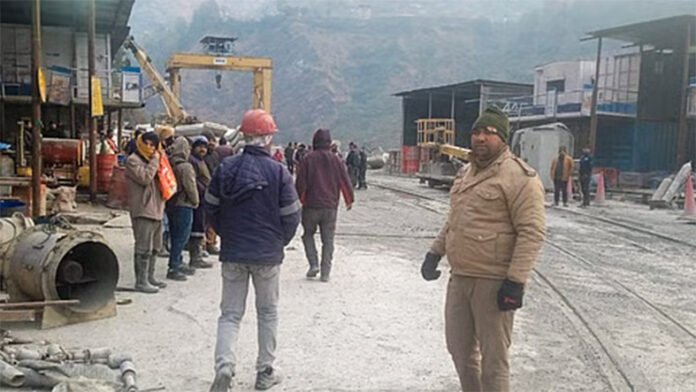
At least 88 people were injured after two loco trains collided inside the Pipalkoti tunnel of the under-construction Vishnugad–Pipalkoti hydropower project in Chamoli district on Tuesday night, officials said.
The accident occurred around 8.30 pm at the Tunnel Boring Machine (TBM) site inside the tunnel being constructed by THDC (India). One of the loco trains was carrying workers and officials for the night shift, while the other was transporting construction material.
According to Chamoli District Magistrate Gaurav Kumar, the train carrying workers had travelled nearly two kilometres inside the tunnel when another loco train approaching from the opposite direction lost control and rammed into it. At the time of the accident, 109 people—mostly labourers—were on board the workers’ train.
Uttarakhand Chief Minister Pushkar Singh Dhami directed authorities to ensure proper medical treatment for all the injured. The District Magistrate and Superintendent of Police Surjit Singh Panwar visited Gopeshwar District Hospital to assess the condition of those injured.
Officials said none of the injured suffered serious injuries. Seventy labourers were brought to the district hospital in Gopeshwar, where 66 were discharged after receiving first aid, while four remain under treatment. Another 18 labourers were given first aid at Vivekananda Hospital in Pipalkoti and later sent home.
Meanwhile, the Railways clarified that the trains involved in the collision had no connection with Indian Railways. In a statement, it said the incident involved a trolley-based transportation system used locally within the tunnel during the construction of the hydropower project, and not an Indian Railways train.
Officials explained that rail-like vehicles are commonly used inside long tunnels to transport workers, staff and construction material during excavation and related works.
The Vishnugad–Pipalkoti hydropower project, located between Helang and Pipalkoti on the Alaknanda River, is designed to generate 444 megawatts of electricity through four turbines and is targeted for completion next year.