



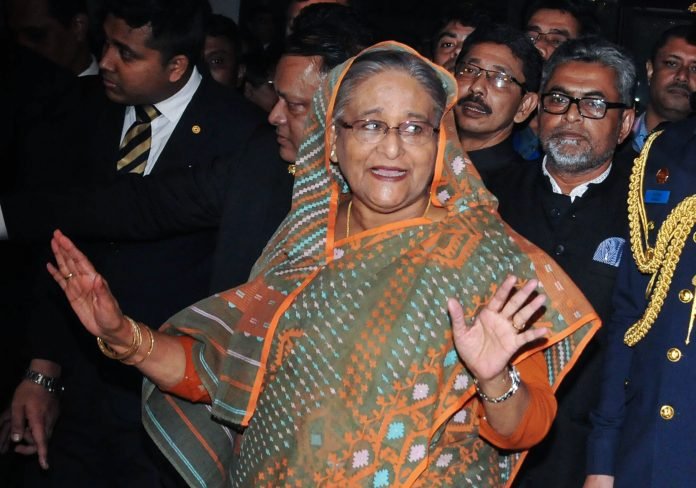
Sheikh Hasina, the ousted former Prime Minister of Bangladesh, has declared her return to the country rests on three critical conditions: the restoration of participatory democracy, lifting the ban on her party, the Awami League, and ensuring free, fair, and inclusive elections. In an exclusive email interview with PTI from a secure location in India, Hasina outlined her stance towards the interim government led by Dr. Muhammad Yunus.
Hasina, Bangladesh’s longest-serving leader, finds herself in exile since August 5, 2024, following significant anti-government protests that forced her resignation amid escalating unrest. Her absence marks a pivotal moment in Bangladeshi politics, and she emphasizes that any chance of her return involves the unequivocal restoration of democracy in her homeland.
“The most important condition for my return to Bangladesh is the same condition that the Bangladeshi people require: a return to participatory democracy,” Hasina stated. She firmly insists on the interim government reversing its ban on the Awami League and allowing for an inclusive political process.
Grateful for India’s Support
In her correspondence, Hasina expressed heartfelt gratitude to the Indian government and its citizens for offering her sanctuary during this tumultuous time. “I am immensely grateful to India’s government and its people for their kind hospitality,” she noted, reflecting her trust in India as a pivotal ally.
On the subject of allegations relating to her government’s handling of the unrest, Hasina acknowledged the loss of control but attributed it to provocateurs among the protesting groups. “Obviously, we lost control of the situation, and that was regrettable,” she said, implicitly calling into question the motives of certain student-led factions.
Rejecting Boycott Claims
In light of reports that suggested she may support a boycott of the upcoming February elections, Hasina flatly denied these claims. She firmly posited that any elections excluding the Awami League would lack legitimacy. “Tens of millions of people support us… It would be a huge missed opportunity for a country that badly needs a government with genuine consent of the people,” she argued, underlining her party’s widespread grassroots support.
Critique of the Yunus Administration
In a forceful critique, Hasina lambasted the Yunus administration for its handling of diplomatic relations with India. She reiterated that Yunus’s alleged hostility towards India jeopardizes Bangladesh’s long-standing strategic partnership with its neighbor. “Yunus’ hostility to India is foolish and self-defeating… He is unelected, chaotic, and dependent on extremist forces,” Hasina remarked, warning that Yunus’s actions could irrevocably damage bilateral ties.
Addressing Indian citizens concerned by the current political climate in Bangladesh, Hasina reassured them that the interim government does not represent the will of the Bangladeshi people. “India is and will remain our nation’s most important friend,” she affirmed, expressing her commitment to restoring strong ties once democracy returns.
Willingness to Stand Trial
Hasina also expressed her readiness to face trial under international supervision, even before the International Criminal Court (ICC). “I would be happy to stand trial under international monitoring, as I believe an impartial tribunal would acquit me,” she stated, casting doubt on the legitimacy of the domestic tribunal that has sought the death penalty against her.
She condemned the Bangladesh International Crimes Tribunal as a politically motivated body, dismissing it as a “kangaroo tribunal” designed to neutralize her and the Awami League politically. Hasina described current efforts to eliminate her party as broader attempts to undermine democracy in Bangladesh. “The fact that they would use the death penalty to silence opponents shows how little respect they have for democracy or due process,” she asserted.
Moreover, Hasina criticized Yunus for losing the support of some international liberals who initially backed him. She noted that dwindling confidence stems from his alignment with extremists, discrimination against minorities, and constitutional dismantling. “The world is beginning to see the reality behind his façade,” Hasina concluded, underscoring the shifting dynamics within Bangladeshi politics.