



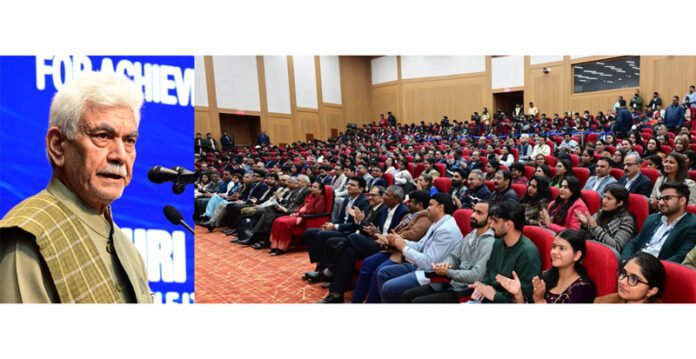
Lieutenant Governor Manoj Sinha announced on Monday that large parts of India have successfully broken free from terrorism, emphasizing that most northeastern states are now terrorism-free. He noted that local recruitment into terrorist ranks in Jammu and Kashmir has sharply diminished, with almost no new recruits reported.
Speaking at the three-day Strategic Management Forum (SMF) Conference focused on achieving a Viksit Bharat by 2047 at the Indian Institute of Management (IIM), Jammu, Sinha highlighted the significant reduction in threats posed by left-wing extremism and Naxalism.
“Most parts of the country have been freed from terrorism. Apart from a few areas, the majority of the northeast now stands terrorism-free. The menace of left-wing extremism and Naxalism, which previously aimed to create a corridor from Hyderabad to Nepal, has been restricted to just two or three districts,” Sinha stated.
Discussing the state of Jammu and Kashmir, he declared that no prominent commander from terrorist organizations operating in the area remains alive. “Local recruitment has seen a drastic drop. Only one or two youths are getting recruited now,” he explained.
However, he cautioned against Pakistan’s attempts to infiltrate terrorists across the border. “Infiltrators are taking refuge in dense forests and rugged terrain, but I assure you they will be eliminated. No matter how long it takes, they will not survive,” he asserted.
Sinha acknowledged a shift in the nature of terrorism, indicating that educated individuals are increasingly becoming involved. He stressed that the fight against terrorism in regions like Jammu and Kashmir, as well as Karnataka and Kerala, cannot solely rest with security forces.
“Security forces, society, and specific branches of the administration must collaborate in this battle,” he emphasized.
The Lieutenant Governor underscored the importance of moving beyond the divisive “insider-outsider” narrative, which he believes impedes development.
He articulated a vision for India’s growth trajectory, stating that policymakers and business leaders play a vital role in addressing the challenges and seizing opportunities in a dynamic global environment.
“We should prioritize macroeconomic stability, increased investment in health and education, digital tools, participatory governance, and expedited project implementation,” Sinha added.
He praised India’s rapid growth under Prime Minister Narendra Modi’s leadership as unprecedented. “Industry leaders now express renewed confidence as sectors such as manufacturing, services, and handicrafts are competing on global platforms. The Prime Minister’s call for Swadeshi has invigorated these industries,” he noted.
The Lieutenant Governor also addressed Jammu and Kashmir’s untapped economic potential, particularly in its mining sector. “J&K is rich in reserves of limestone, sapphires, lithium, and other minerals. With strategic planning, an additional revenue of ₹15,000 to ₹20,000 crores could be generated within five to seven years,” he stated.
Furthermore, he advocated for maximizing the state’s hydropower resources and suggested necessary updates to the Holistic Agriculture Development Programme (HADP) to adapt to changing economic realities.
He concluded by highlighting cultural heritage, unveiling the Basohli Painting Exhibition, and praising artists at the affiliated Basohli Painting Workshop. “Basohli Painting represents our invaluable artistic heritage,” he affirmed, commending the collaborative effort of IIM Jammu and the Indira Gandhi National Centre for the Arts (IGNCA).
The event witnessed the presence of notable figures including Prof. B.S. Sahay, Director of IIM Jammu; R.K. Chaudhary, Chairman of JERC J&K and Ladakh; Subash Chandra Meena, Economic Advisor of NITI Aayog; Prof. Arunaditya Sahay, Founding Chairman of SMF; Ramesh Kumar, Divisional Commissioner Jammu; and Shruti Awasthi, Regional Director of IGNCA, alongside various academicians, policymakers, industry leaders, artists, and students.