


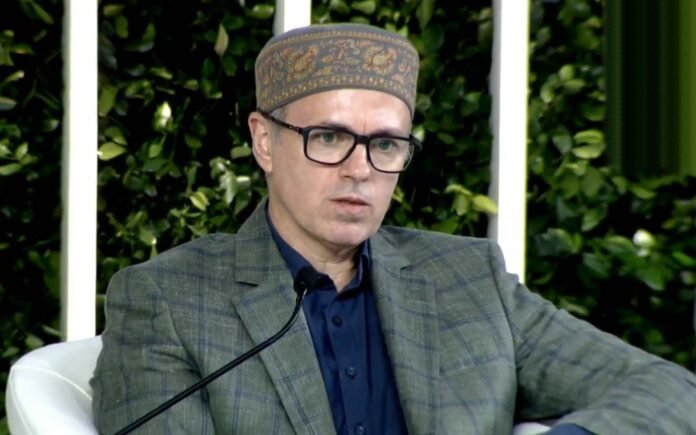
Jammu and Kashmir Chief Minister Omar Abdullah voiced serious concerns about the current status of his office, branding it as one of “disempowerment” during a recent event. He stated he experiences a “unique misfortune” transitioning from heading a state with significant powers to managing a Union Territory that limits his authority compared to other state leaders.
“The circumstances are not only challenging but also deeply frustrating,” Abdullah remarked, emphasizing the unique challenges a Union Territory brings. He cited frequent interference from the Lieutenant Governor’s office, which undermines the roles assigned to democratically elected officials.
During his address, Abdullah reiterated his demand for a defined timeline for the restoration of Statehood in Jammu and Kashmir. He expressed difficulty reconciling the terms “Union Territory” and “Jammu and Kashmir,” stating, “I hate being reminded that we are a Union Territory.” This sentiment resonates across a wide spectrum of public opinion in the region.
In his critique, Abdullah labeled the power dynamics as “asymmetrical.” He noted that Lieutenant Governor Manoj Sinha continues to perform functions traditionally reserved for an elected government, including chairing significant meetings that primarily involve local governance.
“What business does someone responsible for security have holding a tourism meeting?” Abdullah questioned, highlighting the disconnect between the Union Territory administration and the needs of its people. He added that several cabinet decisions, including modifications in reservation percentages, remain pending before the Lieutenant Governor.
The Chief Minister reminded the Central Government of its outlined three-step process to restoring Statehood: delimitation, elections, and Statehood itself. “Two steps are complete. Why are we made to wait for the third?” he asked, demanding clarity and transparency about the timeline.
Abdullah insisted that the Centre should clearly communicate what constitutes ‘appropriate time.’ He warned that vague promises lead to frustration among citizens. “If it is when the BJP comes to power, then be honest so people can decide,” he challenged.
On the topic of cancelling Article 370, Abdullah remained critical, asserting that the restoration is only feasible after a shift in the Central Government. “It is pointless asking those who took it away from us to give it back,” he stated, maintaining his advocacy for special status without making unrealistic promises.
Discussing broader social issues, Abdullah warned against the rise of hyper-nationalism leading to radicalisation. He criticized punitive measures, like demolishing houses after terror attacks, that affect innocent families. “If those people are radicalised, whose fault is it?” he pressed, emphasizing the necessity of fair and responsible governance.
Abdullah also referenced recent controversies affecting majority Muslim constituencies in government selections, urging the need for inclusivity. “When you push an entire community to the margins, how can you expect no reaction?” he added, highlighting the dire need for balanced representation in all aspects of governance.
At a national level, Abdullah described the INDIA bloc as being in a precarious situation, lacking focus on critical matters like Article 370. He mentioned Congress leader Rahul Gandhi’s silence regarding the issue, supporting the idea that political leaders must prioritize winning elections before tackling sensitive topics.
Diverging from his father, Farooq Abdullah’s viewpoint, Omar dispelled claims of EVM tampering. He emphasized that stakeholders need to accept their defeats and learn from the electoral process instead of attributing loss to external factors.
Discussing economic issues, Abdullah remarked on the environmental challenges facing Jammu and Kashmir, especially in Srinagar. He pointed to pollution exacerbated by the valley’s geography, leading to prolonged dry spells and trapping smog.
Abdullah sought to rectify misconceptions about tourism being the principal economic driver for Jammu and Kashmir. He clarified that tourism ranks fourth in contributing to the Gross State Domestic Product, following agriculture, horticulture, and industry. “We need a balanced approach towards developmental frameworks,” he concluded, stressing the importance of diversification in economic strategies for sustainable growth.